

Press Release
New Study Finds Three Forces Redefining Elite College Placement Race: Wealthy Coastal Gaps, Heartland Public Wins, and Squeezed Middle Crisis
New research, based on the Elite College Placement Index (ECPI), identifies three competing forces redefining high school success: entrenched private school dominance in coastal cities, the surprising rise of elite public charter schools in heartland metros, and a growing equity crisis for "squeezed" traditional schools.
REDWOOD CITY, CA, November 5, 2025. Updated March 24, 2026.
As a divisive national debate intensifies over the future of American public education—pitting calls for 'accountability and outcomes' against demands for 'investment in traditional schools'—Chicardgo School today published a new in-depth analysis of high school performance based on placement into Top 25 National Universities. The study, drawing from the Elite College Placement Index (ECPI), identifies three competing forces redefining high school success: the entrenched dominance of private schools in coastal cities, the surprising rise of elite public charter schools in heartland metros, and a growing equity crisis creating a "squeezed middle" in traditional public schools.
The full analysis is available today at school.chicardgo.com/analysis/. The research provides critical, real-world data that speaks directly to all sides of this political debate. It delivers the objective "outcome-based" metrics that school-choice reformers are demanding, while also quantifying the consequences of those models on traditional districts—a core concern of public school defenders. By moving beyond political rhetoric to measure actual results, the analysis provides a clear-headed tool for policymakers, educators, and families to see what is working, what is not, and what the real-world trade-offs are.
The full analysis uses public and private high school matriculation data from the 2023-2025 period, covering 30 major U.S. metropolitan areas to provide a comprehensive and current picture of the national landscape.
KEY FINDINGS: A FRACTURING LANDSCAPE
1. Wealthiest Metros, Largest Gaps
The analysis confirms that in the nation's wealthiest coastal hubs, a massive performance gap persists between elite private "super schools" and public schools. This data quantifies the gap at the center of the school choice and voucher debate, showing a massive performance divide.
- New York City & the Bay Area: The gap is most extreme in NYC, where private schools outperform public schools by a 33.5 percentage point gap (7x higher). The Bay Area follows closely behind with a 32.0 point gap (5x higher).
- Los Angeles & Washington, D.C.: Private schools in these hubs outperform public schools by a significant 18.0 point gap.
- Boston: Despite having some of the strongest public schools in the nation, the private school median still outperforms the public median by a 12.5 point gap (2x higher).
- The "Price of Admission": Public school success in these metros is severely isolated in wealthy enclaves (e.g., Cupertino, CA; Weston, MA), where a high mortgage effectively serves as the "price of admission" to a top traditional school.
2. The Public Counter-Narrative: Heartland Schools Are Winning
Countering the "public school peril" narrative, the analysis reveals that specialized public schools (charter & magnet) in heartland metros are actively closing the gap and outperforming local private schools. This trend offers an elite, publicly-funded pathway that challenges the high cost of private tuition.
- Phoenix: The median charter school (~14%) dramatically outperforms the median private school (~8%). This is driven by elite charter networks providing results that rival top coastal private schools.
- Nashville: Top-tier public magnet schools outperform the private school median by nearly 3-to-1.
- Heartland Dominance: Specialized public school medians are also outperforming private school medians across major metros including Orlando, Detroit, Indianapolis, Kansas City, and Milwaukee.
3. The Squeezed Middle: A National Dilemma
While celebrated, the success of specialized schools often hollows out traditional neighborhood schools, creating a two-tier public system. This "squeezed middle" dynamic provides the first concrete data for policymakers concerned about the sustainability of "choice" models on the broader public system.
- New Orleans: Top specialized schools achieve T25 placement rates 11.0 times higher than the average traditional public school.
- Charleston & Austin: Top magnet programs outperform traditional schools by 6.0x and 5.8x, respectively.
- Nationwide Stratification: The internal gap is severe across the country, including Nashville (5.5x), Orlando (5.0x), Las Vegas (4.5x), and Portland (4.3x), demonstrating a widespread hollowing-out of traditional neighborhood schools.
Visual Data: Revealing the National Divide
The full analysis includes interactive geographic mapping that visualizes these competing national trends, providing an at-a-glance summary for policymakers and families.
Private vs. Public Gap Map
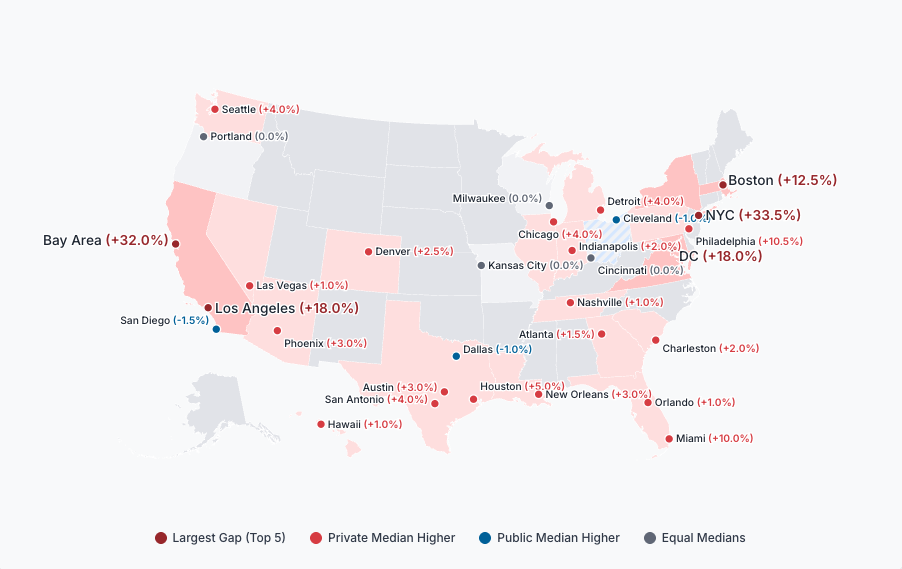
Visualizes the T25 matriculation gap. Highlights where private schools heavily dominate (e.g., NYC, Bay Area) versus cities where the public median outperforms (e.g., Phoenix, Dallas).
Specialized vs. Traditional Public Map
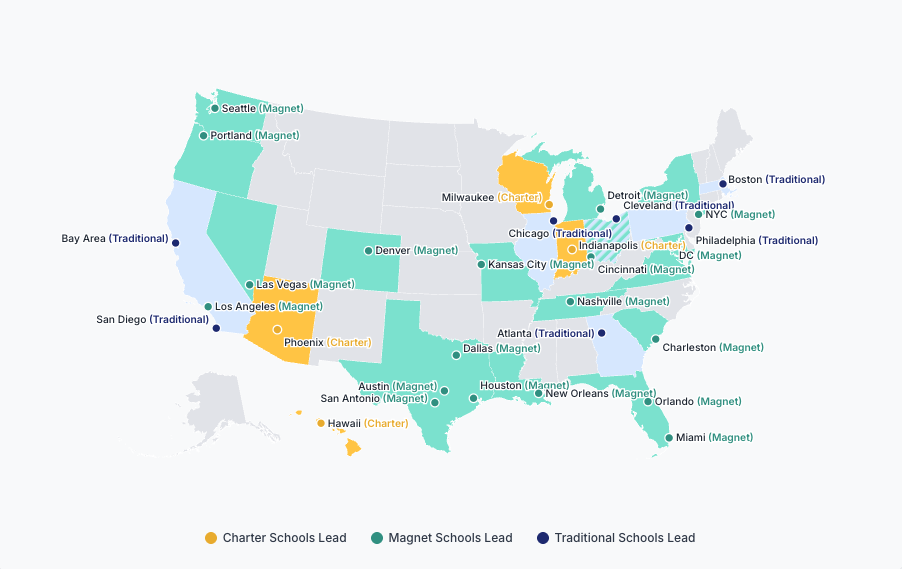
Shows which public school type has the highest median placement rate in each metro—traditional (blue), charter (yellow), or magnet (green).
The "Squeezed Middle" Advantage Map
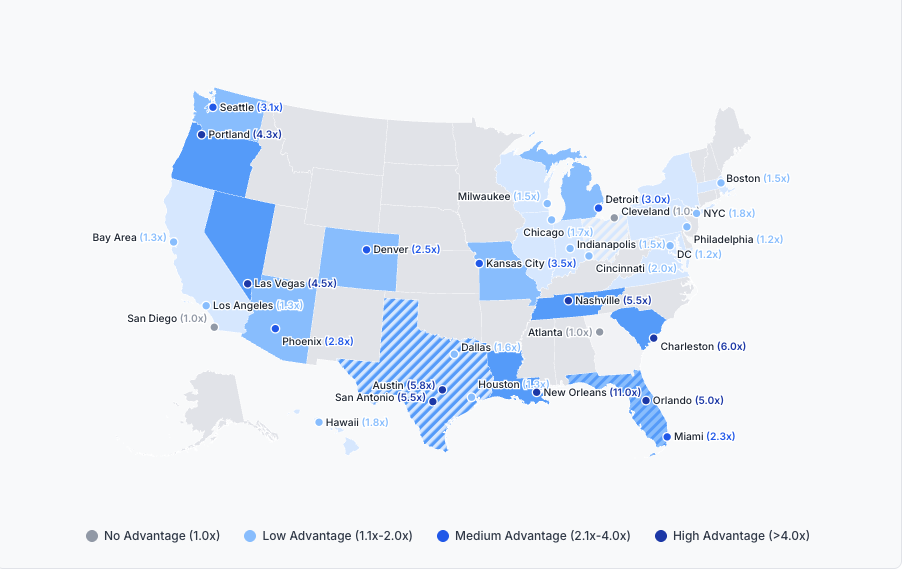
Visualizes the "Squeezed Middle" effect, mapping out the specific multiplier advantage top specialized programs hold over traditional neighborhood schools in the exact same city limits.